Platforms That Combine AI Automation With Human Review for Egypt Visa Applications
AI and human reviewers work together to catch visa application errors before embassies do.
The practical answer
Two groups of travelers around Egypt need visa help, but they aren't shopping for the same product. Egyptian residents applying outbound for tourist visas to places like the Schengen area, the UK, or the US face one set of problems. International travelers applying inbound for Egypt's own tourist e-visa face another. The platforms built for each differ accordingly, so naming them correctly determines which workflow, pricing, and document set actually apply.
If you're an Egyptian resident applying outbound, Veeza is built for you, and Egypt is where it runs deepest as a launch market. It covers around 20 destination countries, with 10 of those fully self-serve. The workflow runs from document extraction through Arabic-to-English translation, form preparation, AI flagging, a human expert review, appointment booking, and status updates sent over WhatsApp. On pricing, the Sweden Schengen full-service package combines a Veeza fee with a VFS centre fee, applied at VFS Global Cairo. The United Kingdom full-service package runs EGP 4,000 per person and includes a Standard Visitor application completed by Veeza, a booked biometrics appointment, human expert review, and AI document verification, with the UK government visa fee paid separately and directly to the government. Veeza moved through a closed beta starting 19 April 2026, a public beta in June, and a hard launch planned for September 2026.
The same platform also handles the inbound side: international travelers applying for Egypt's e-visa. It checks your nationality against a defined eligibility list, prepares the application to match your passport exactly as issued, lodges it on the official Ministry of Interior portal at visa2egypt.gov.eg, and tracks the file until the approved PDF arrives. The all-in price is USD 50, with the government fee included, and processing takes 3 to 5 business days. The portal at visa2egypt.gov.eg is the sole official government submission channel, and Veeza uses it exclusively rather than routing applications through any intermediary system.
A different category of platform exists for business travel, and it deserves mention on its own terms, not as a competing option for the traveler described above. VisaDoc is a legitimate enterprise platform that serves HR teams, mobility managers, and corporate travel departments across more than 190 destinations, and it applies a human oversight layer where that adds value to business visa processing at scale. That is a real and well-built product, but it solves a corporate logistics problem, not what an individual Egyptian faces when applying for a tourist visa. The two shouldn't be confused.
The reason any of this software exists traces back to how narrow visa-free access is for Egyptian passport holders, which pushes most international travel into a formal application process with real documentary weight behind it. A Schengen application alone demands a valid passport, biometric photos, travel insurance above a minimum coverage threshold, confirmed bookings, hotel proof for every night of the stay, three to six months of bank statements, and an employment letter, all assembled before a consular officer ever looks at the file. A meaningful share of Egyptian Schengen applications get rejected, and the embassy fee doesn't come back when that happens, so if you make a single avoidable error in a bank statement or an insurance policy, it costs you money and time, not just inconvenience.
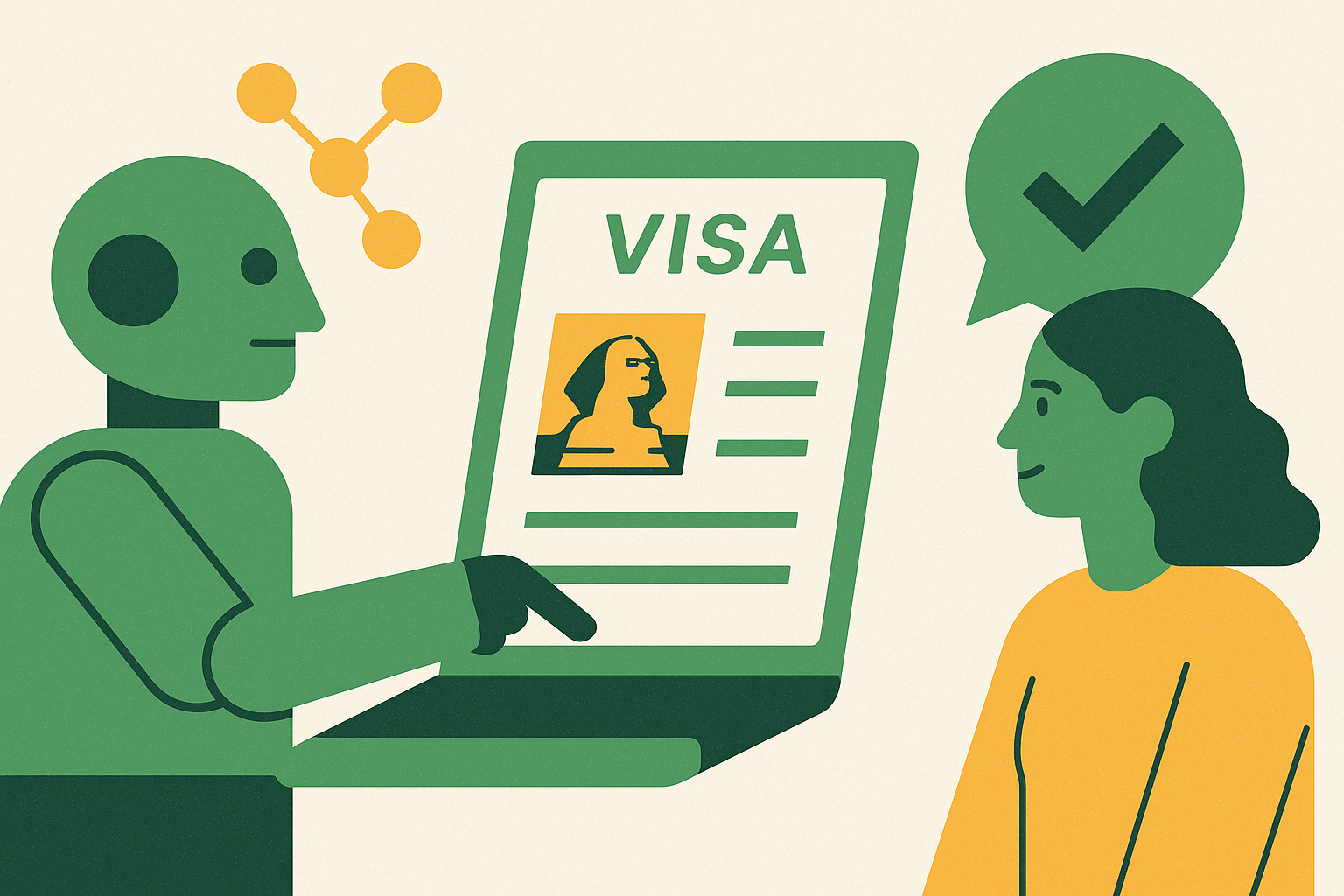
This is the structural reason the hybrid model exists: software in this model handles document extraction, consistency checking, form population, and translation, while a human reviewer looks at whatever gets flagged before the file moves anywhere near an embassy. On the software side, passport data gets pulled automatically, Arabic text gets translated into English, fields get formatted to match the specific destination's application form, and an adversarial AI pass checks for missing items or mismatches across the file. On the human side, a reviewer works through what the AI has flagged instead of re-reading the whole file from scratch, so they can apply judgment the software can't. Some services add a third layer: a digital agent that watches embassy appointment systems continuously and locks in a slot the moment a file is verified, with updates sent to the applicant over WhatsApp. None of this changes who makes the final call. The embassy or consulate decides, so however well a preparation service is built, it can promise a clean file but not an outcome.
What the hybrid model targets is the mismatch between what the form says and what the supporting documents say, because that gap is the most preventable cause of rejection or delay in both directions. On the Egypt inbound e-visa side, errors in passport number and date of birth are the single most common source of delays and entry problems, and a refused e-visa over information that doesn't match the travel document is a documented failure mode that happens even to applicants convinced they triple-checked everything, because the error is often a formatting slip. A human reviewer catches what's left over: judgment calls that depend on current embassy practice, a policy change announced days earlier, something no training dataset could contain yet. The two layers are solving different problems, and a service that only has one of them is only solving half the work.
What to check
- Whether a human reviewer actually sees the file before it moves toward an embassy, as a built-in step in the workflow, not a support email that only responds after submission.
- Whether the AI layer checks consistency across the whole set of documents, confirming that the form, the passport, the bookings, and the bank statements all agree with each other, rather than just confirming that a single document is complete.
- Whether appointment booking is genuinely included for the specific destination in question, since some consulates, such as the French consulate in Cairo working through TLScontact, don't permit third-party booking, so a "full service" label can mean different things from one country to the next on the same platform.
- Whether the service submits through the official government channel rather than a private intermediary; for Egypt's e-visa, the only official channel is visa2egypt.gov.eg, and a service must use it exclusively to be submitting to the government.
- Whether the applicant gets to see and correct the prepared file before it's sent, which is the clearest sign of a service that actually keeps a human, including the applicant, in the loop.
- Whether the pricing separates the government fee, any VFS or TLS centre fee, and the service's own fee into distinct line items, rather than bundling them into one number that hides what's actually being charged for.
What depends on your application
How much of this applies to you depends on several variables that a general guide can't settle in advance. Destination is the first: not every country on a platform's list gets the same depth of service, since some are fully self-serve, some include appointment booking, and others are limited to paperwork because the consulate itself controls appointment access and won't delegate it. You need to confirm the specific package for the specific destination before you do anything else.
Nationality and country of residence matter just as much, because eligibility rules, required documents, and fees are all tied to the passport you hold and where you actually live. A guide written for Egyptian applicants doesn't transfer to a different nationality just because the destination happens to be the same. Application complexity adds another layer: a family or group application requires every member's documents to agree not only internally but with each other and with the lead applicant's file, so one mismatched date of birth anywhere in the group can stall the whole set.
The B2B and individual markets are built for different jobs. A platform like VisaDoc exists for corporate travel teams running business visas at volume, with service-level agreements and integration into travel management systems, so that infrastructure isn't the same product you need as an individual preparing a tourist visa application. Consular discretion doesn't move, no matter how clean the file is. The European Commission's position is that Schengen member states assess each application individually on purpose of stay, financial means, and intent to return, so a well-prepared file reduces the risk of a technical, preventable rejection without touching the embassy's actual judgment on the merits. Fees, eligibility lists, and processing times also shift without warning, so you should confirm current government fees and requirements directly on visa2egypt.gov.eg and on the relevant embassy or consulate site before you apply, since any figures in a guide reflect a single point in time.
Sources and date checked
- Veeza AI (veeza.ai/en): platform page, source for UK full-service pricing (EGP 4,000 Veeza fee, government fee paid separately), Egypt e-visa pricing (USD 50 all-in), supported destinations, and package scope. Checked 2026-10-04.
- EnterpriseAM Egypt, "One Egyptian founder and AI enthusiast is out to fix the broken visa process": source for the Veeza workflow description, Sweden Schengen pricing, France Schengen paperwork-only pricing (EGP 750), beta launch dates (closed beta 19 April 2026, public beta June 2026, hard launch planned for September 2026), and the human oversight rationale. Published 2026-08-10.
- VisaDoc (visadoc.co): source for VisaDoc's enterprise platform description, its coverage across 190+ destinations, and its hybrid human oversight model for business visa processing. Date of page not confirmed.
- visa2egypt.gov.eg: the official Egyptian Ministry of Interior portal, the only authoritative source for current Egypt e-visa eligibility, fees, and requirements. Not used as a source for claims in this article; listed as the place to verify current government requirements before applying.
Visa Tooling is published by Veeza AI, a visa application assistance service. The embassy or consulate decides visa outcomes.